Question 1 of 10
In the food web below, what would happen if all the frogs were removed? 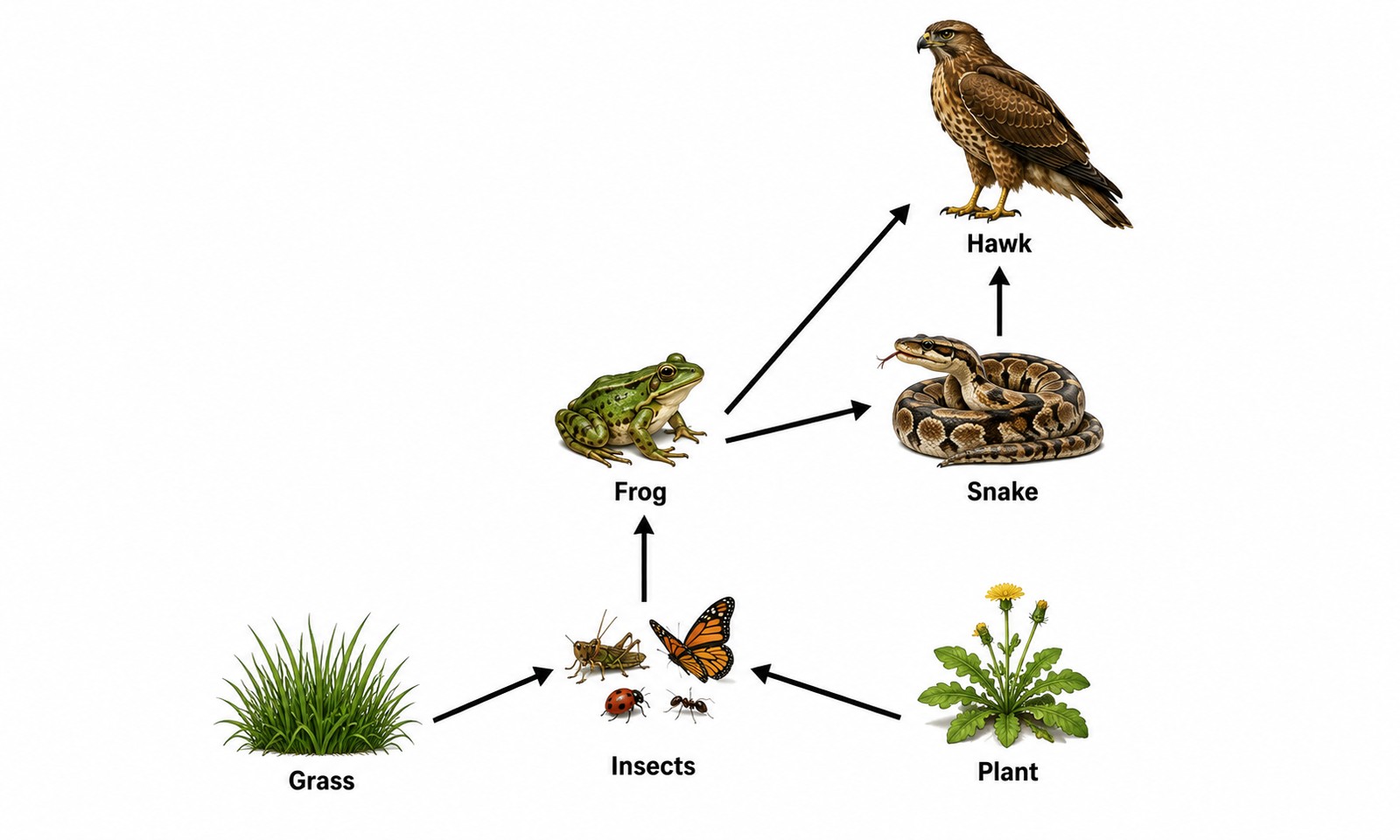
ASnake population increases
BInsect population increases and snake population decreases
CNothing changes
DAll organisms die
Explanation
📌 If frogs are removed:
• Insects (grasshoppers) they ate would INCREASE (no predator)
• Snakes that ate frogs would DECREASE (less food)
• This demonstrates how removing one species affects the entire food web.
• Insects (grasshoppers) they ate would INCREASE (no predator)
• Snakes that ate frogs would DECREASE (less food)
• This demonstrates how removing one species affects the entire food web.
Question 2 of 10
All three domains of life (Bacteria, Archaea, and Eukarya) share which structural feature?
AChloroplasts for photosynthesis
BA membrane-bound nucleus
CMulticellular organization
DRibosomes for protein synthesis
Explanation
All cellular life — Bacteria, Archaea, and Eukarya — uses ribosomes to build proteins. Distractors: a membrane-bound nucleus is found only in Eukarya (Bacteria and Archaea are prokaryotic). Multicellularity appears only in some Eukarya — most life is unicellular. Chloroplasts are organelles found only in plants and algae (a subset of Eukarya).
Question 3 of 10
Which pair of processes drives the most direct exchange of CO₂ between living organisms and the atmosphere?
ANitrogen fixation (absorbs CO₂) and decomposition (releases O₂)
BPhotosynthesis (releases CO₂) and cellular respiration (absorbs CO₂)
CTranspiration (releases CO₂) and condensation (absorbs CO₂)
DPhotosynthesis (absorbs CO₂) and cellular respiration (releases CO₂)
Explanation
Photosynthesis consumes atmospheric CO₂ to build glucose (CO₂ → sugar), while cellular respiration breaks glucose back down to CO₂ and water. Together they form the short-term carbon cycle between the biosphere and atmosphere. Distractor B reverses the direction. Transpiration moves water vapor, not CO₂. Nitrogen fixation moves nitrogen, not carbon.
Question 4 of 10
The graph shows the change in a moth population over time. Dark moths increased after industrial pollution darkened tree bark. This is an example of:
AArtificial selection
BSpontaneous generation
CNatural selection
DGenetic engineering
Explanation
📌 This is the classic peppered moth example of natural selection.
Before pollution: light bark → light moths camouflaged → survived
After pollution: dark bark → dark moths camouflaged → survived
The environment selected for the trait that provided camouflage.
Before pollution: light bark → light moths camouflaged → survived
After pollution: dark bark → dark moths camouflaged → survived
The environment selected for the trait that provided camouflage.
Question 5 of 10
Which molecule carries energy from glucose breakdown to the electron transport chain?
AH2O
BNADH
CATP
DCO2
Explanation
📌 NADH and FADH2 are electron carriers. They transport high-energy electrons from glycolysis and Krebs cycle to the ETC.
Question 6 of 10
In a DNA nucleotide, which component carries the genetic code through its specific sequence?
ANitrogenous base
BDeoxyribose sugar
CHydrogen bond
DPhosphate group
Explanation
The nitrogenous base (adenine, thymine, guanine, or cytosine) is the part of a DNA nucleotide that varies — its sequence along the strand IS the genetic code. The phosphate and deoxyribose sugar are identical in every nucleotide and form the structural 'backbone' of the DNA strand; they don't store information. Hydrogen bonds hold the two strands together at the bases but are not part of a single nucleotide.
Question 7 of 10
Which organelle is labeled X in the cell diagram below? 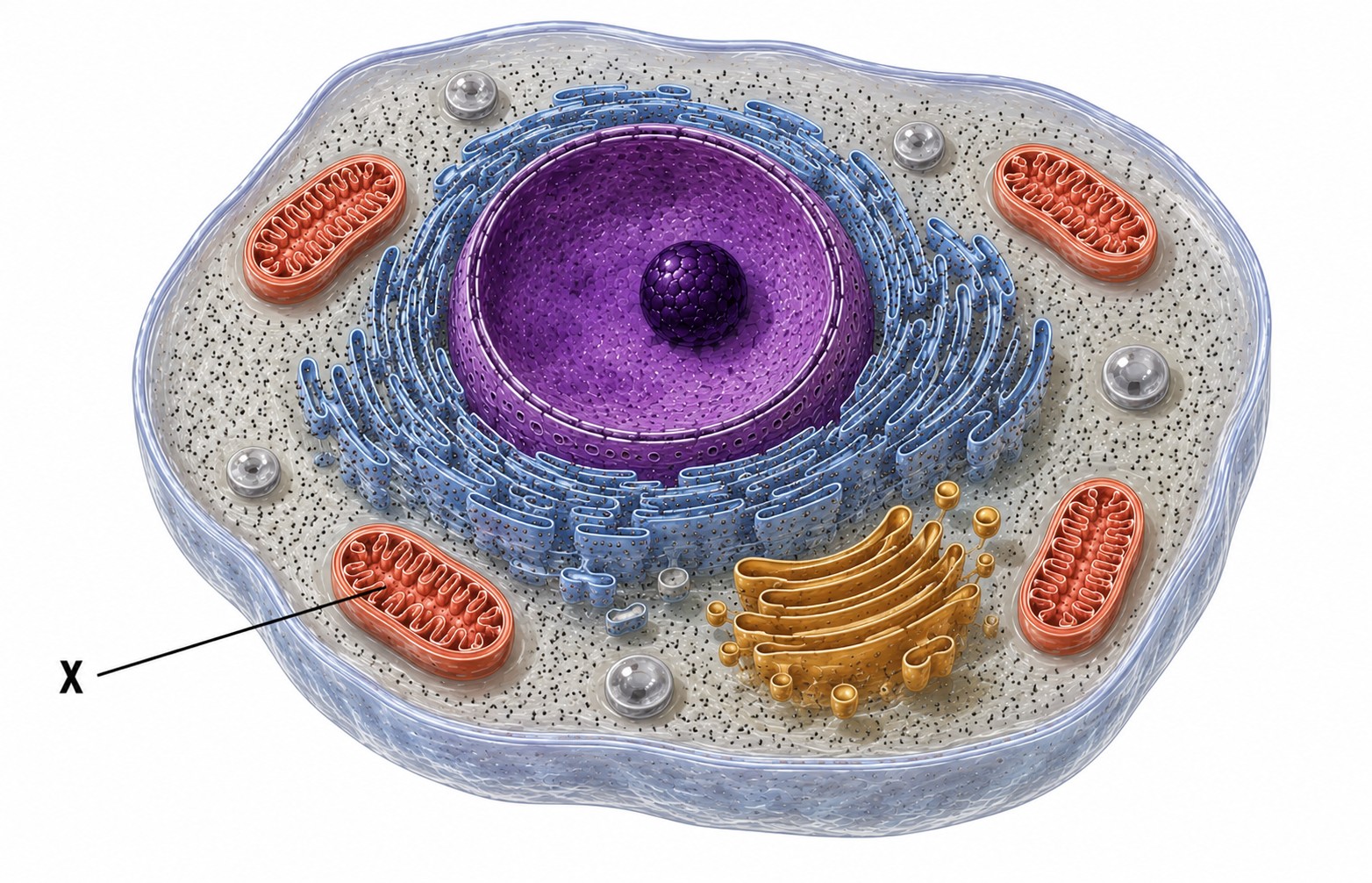
ANucleus
BMitochondria
CGolgi apparatus
DEndoplasmic reticulum
Explanation
📌 Organelle X has the bean-shaped structure with inner folds (cristae) → Mitochondria
Mitochondria = powerhouse of the cell = produces ATP through cellular respiration
C₆H₁₂O₆ + 6O₂ → 6CO₂ + 6H₂O + ATP
Mitochondria = powerhouse of the cell = produces ATP through cellular respiration
C₆H₁₂O₆ + 6O₂ → 6CO₂ + 6H₂O + ATP
Question 8 of 10
The Hardy-Weinberg principle states that allele frequencies remain constant when:
Anatural selection is strong
Bthere is no evolution occurring
Cthe population is very small
Dmutations are common
Explanation
📌 Conditions: no mutation, no migration, random mating, large population, no natural selection.
Any violation → evolution occurs.
Any violation → evolution occurs.
Question 9 of 10
Epigenetics studies how:
ADNA sequence changes
Bcells divide
Corganisms evolve
Dgene expression changes without altering DNA sequence
Explanation
📌 Epigenetics = changes in gene expression WITHOUT changing DNA sequence.
Mechanisms: DNA methylation, histone modification.
Affected by environment, diet, stress.
Mechanisms: DNA methylation, histone modification.
Affected by environment, diet, stress.
Question 10 of 10
The carbon cycle involves:
Aonly the atmosphere
Bonly living organisms
Cthe movement of carbon through living and non-living systems
Donly the ocean
Explanation
📌 Carbon moves through: atmosphere (CO₂) → photosynthesis → organisms → respiration/decomposition → atmosphere.
Also: fossil fuels → combustion → atmosphere.
Also: fossil fuels → combustion → atmosphere.